
Posts
Doctor's Day
July 2, 2026
PCOS now PMOS
June 2, 2026
Kidney Day Nutrition Awareness
March 11, 2026
Post-Holi Health Reset: Simple Diet & Lifestyle Tips:-
March 6, 2026
#Mineral #Rich #Immunity #Diet:-
March 5, 2026
After Holi Detox Diet
March 5, 2026
The Dawn of a New Era: How AI is Revolutionizing Drug Discovery
February 16, 2026
FDA Approves First-of-Its-Kind Device to Treat Pancreatic Cancer
February 16, 2026
The Hidden Gut Bacteria That Could Revolutionize Your Health
February 15, 2026
The Future of Diagnosis: How AI is Revolutionizing Brain Scans
February 14, 2026
Scientists Discover Protein That Can Rejuvenate Aging Brain Cells
February 13, 2026
A New Dawn for Pancreatic Cancer Treatment: FDA Approves First-of-Its-Kind Wearable Device
February 13, 2026
AI Revolutionizes Brain Scan Analysis, Offering Diagnoses in Seconds
February 12, 2026
Managing Flu Season: A Guide for 2026
February 12, 2026
Your Immune System's Molecular Diary: How Life Experiences Shape Your Health
February 11, 2026
The Origami of Life: How DNA Folding and Immune System Secrets are Revolutionizing Medicine
February 10, 2026
Revolutionary AI Technology Reads Brain MRIs in Seconds: A Game-Changer for Neurological Diagnosis
February 10, 2026
Your Guide to Ayushman Bharat at Saksham Hospital, Saharanpur
November 17, 2025
A Beautiful Gesture of Gratitude: Akanksha’s Journey to Motherhood at Saksham Hospital
November 17, 2025
Understanding Nasal Allergy & Turbinate Hypertrophy: Causes, Symptoms & Treatment
November 16, 2025
The Importance of Regular Health Check-ups
October 2, 2025
❤️ Your Heart Matters: A Guide to Better Heart Health
September 30, 2025
A day in the life of an Obstetrician
September 28, 2025
The Dawn of a New Era: How AI is Revolutionizing Drug Discovery
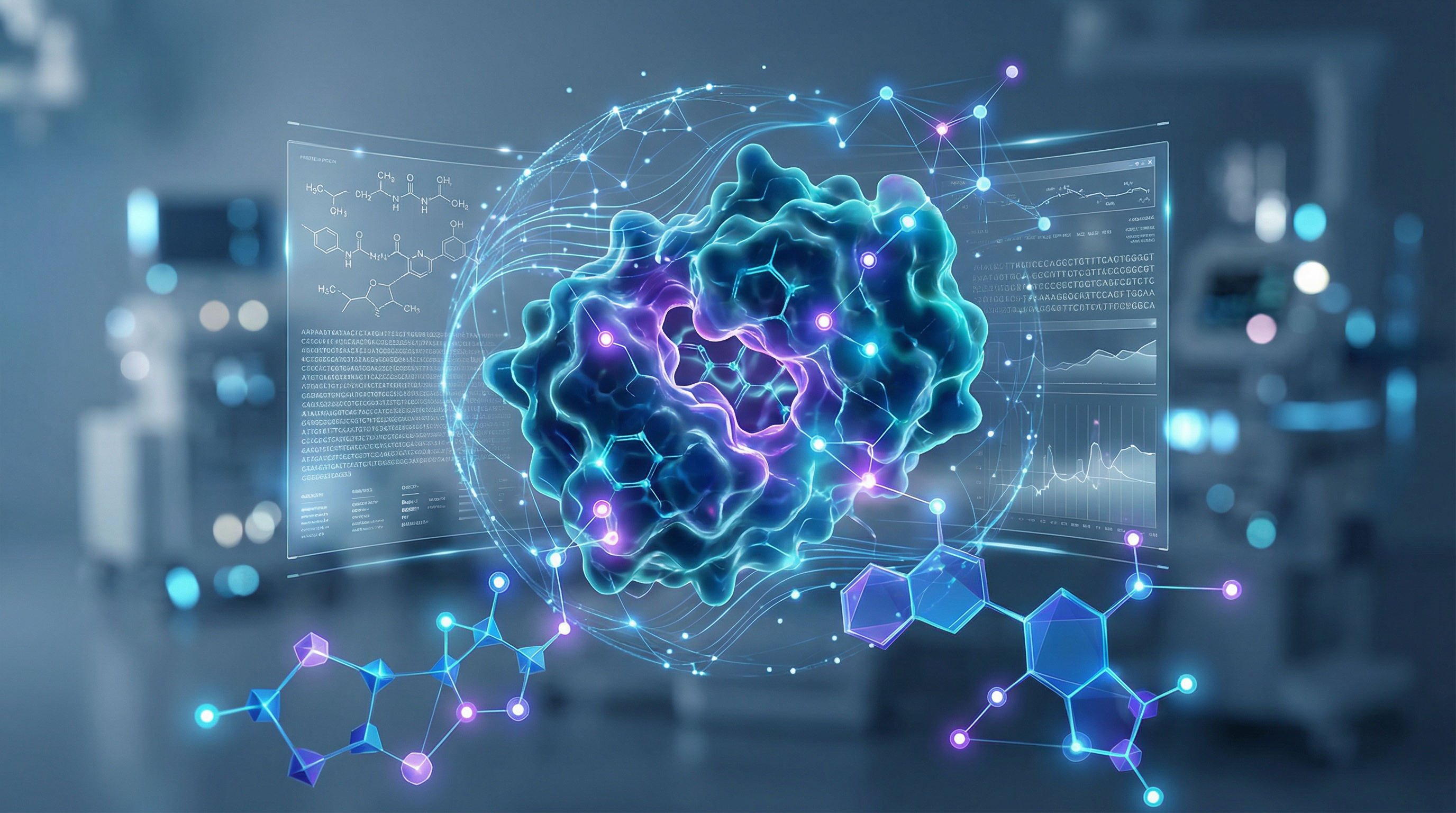
The Dawn of a New Era: How AI is Revolutionizing Drug Discovery
The world of medicine is on the cusp of a transformation so profound it promises to reshape how we combat diseases. At the heart of this revolution lies Artificial Intelligence (AI), a powerful technology that is rapidly moving from a futuristic concept to a practical tool in the hands of scientists and researchers. In recent years, AI has begun to tackle one of the most complex and time-consuming challenges in healthcare: drug discovery. This article explores a groundbreaking AI tool that is accelerating this process at an unprecedented rate and delves into the broader trends of how AI is set to become an indispensable part of creating the medicines of tomorrow.
The Bottleneck in Traditional Drug Discovery
For decades, the process of discovering new drugs has been a long and arduous journey, often described as finding a needle in a haystack. Scientists would spend years, sometimes even decades, manually screening thousands of chemical compounds to find one that could effectively target a specific disease-causing protein. This traditional method, known as molecular docking, is not only slow but also incredibly expensive. Imagine trying to fit countless tiny keys into a complex lock, one by one, until you find the perfect match. That's a simplified analogy for the painstaking work of molecular docking. The sheer scale of this challenge is staggering. The human body has approximately 20,000 protein-coding genes, yet scientists have only been able to find effective small molecule binders for about 10% of them. This leaves a vast landscape of potential therapeutic targets unexplored, simply because the traditional methods are too slow and resource-intensive to keep up.
Introducing DrugCLIP: A Quantum Leap in Drug Discovery
Enter DrugCLIP, a revolutionary AI framework developed by a team of researchers at Tsinghua University in Beijing. Published in the prestigious journal *Science*, DrugCLIP represents a quantum leap in the field of drug discovery. This innovative tool leverages the power of deep learning to dramatically accelerate the process of finding potential drug candidates. Instead of the slow, brute-force approach of traditional docking, DrugCLIP uses a more intelligent and efficient method. It represents both the protein's binding pocket and the potential drug molecule as mathematical vectors in a high-dimensional space. By calculating the relationship between these vectors, DrugCLIP can predict the binding affinity with incredible speed and accuracy. To further refine its predictions, the framework utilizes AlphaFold3, a state-of-the-art AI model for predicting protein structures. The result is a screening protocol that is up to 10 million times faster than traditional docking methods alone. This is not just an incremental improvement; it's a paradigm shift that could unlock new possibilities for treating a wide range of diseases.
From Theory to Reality: DrugCLIP's Real-World Success
The power of DrugCLIP is not just theoretical. The research team has already demonstrated its real-world effectiveness by identifying new molecules for two important targets in psychopharmacology: the serotonin 2A receptor and the norepinephrine transporter. In fact, the molecule targeting the norepinephrine transporter was found to be more chemically effective than bupropion, a widely used antidepressant. This success was not just a computer simulation; the efficacy of these new molecules was confirmed through rigorous laboratory experiments, including biochemical assays and cryo-electron microscopy. The team is so confident in their findings that they are already planning to take another newly discovered molecule to clinical trials. This rapid progression from computational prediction to potential clinical application is a testament to the transformative power of AI in drug discovery.
The Bigger Picture: AI as a Cornerstone of Modern Medicine
The development of DrugCLIP is part of a much larger trend. By 2026, AI is expected to be an integral part of the entire drug discovery and development pipeline. Experts in the field are already witnessing a shift from using AI in isolated applications to embedding it into the core of the research process. AI-guided platforms are now being used to integrate vast datasets from genomics, proteomics, and transcriptomics, revealing hidden patterns and disease mechanisms that were previously impossible to see. This allows scientists to start with a much stronger biological rationale for their research, reducing the number of projects that fail in later stages. Furthermore, AI is making biological modeling and simulation tools more accessible to scientists, allowing them to test their hypotheses computationally before committing to expensive and time-consuming lab work. This iterative process of computational prediction and experimental validation is creating a much more efficient and effective drug discovery workflow. The impact of this transformation is expected to be enormous, with some projections suggesting that AI could generate hundreds of billions of dollars in value for the pharmaceutical sector in the coming years.
The Road Ahead: A Future Powered by AI
The journey of AI in drug discovery is just beginning, but the road ahead is filled with promise. As AI technologies continue to mature and become more integrated into the scientific workflow, we can expect to see an acceleration in the development of new and more effective treatments for a wide range of diseases. From rare genetic disorders to common chronic illnesses, AI-powered drug discovery has the potential to bring hope to millions of patients around the world. The story of DrugCLIP is a powerful example of what is possible when human ingenuity is combined with the power of artificial intelligence. It is a story that is still being written, and the next chapter promises to be even more exciting than the last.