
Posts
Doctor's Day
July 2, 2026
PCOS now PMOS
June 2, 2026
Kidney Day Nutrition Awareness
March 11, 2026
Post-Holi Health Reset: Simple Diet & Lifestyle Tips:-
March 6, 2026
#Mineral #Rich #Immunity #Diet:-
March 5, 2026
After Holi Detox Diet
March 5, 2026
The Dawn of a New Era: How AI is Revolutionizing Drug Discovery
February 16, 2026
FDA Approves First-of-Its-Kind Device to Treat Pancreatic Cancer
February 16, 2026
The Hidden Gut Bacteria That Could Revolutionize Your Health
February 15, 2026
The Future of Diagnosis: How AI is Revolutionizing Brain Scans
February 14, 2026
Scientists Discover Protein That Can Rejuvenate Aging Brain Cells
February 13, 2026
A New Dawn for Pancreatic Cancer Treatment: FDA Approves First-of-Its-Kind Wearable Device
February 13, 2026
AI Revolutionizes Brain Scan Analysis, Offering Diagnoses in Seconds
February 12, 2026
Managing Flu Season: A Guide for 2026
February 12, 2026
Your Immune System's Molecular Diary: How Life Experiences Shape Your Health
February 11, 2026
The Origami of Life: How DNA Folding and Immune System Secrets are Revolutionizing Medicine
February 10, 2026
Revolutionary AI Technology Reads Brain MRIs in Seconds: A Game-Changer for Neurological Diagnosis
February 10, 2026
Your Guide to Ayushman Bharat at Saksham Hospital, Saharanpur
November 17, 2025
A Beautiful Gesture of Gratitude: Akanksha’s Journey to Motherhood at Saksham Hospital
November 17, 2025
Understanding Nasal Allergy & Turbinate Hypertrophy: Causes, Symptoms & Treatment
November 16, 2025
The Importance of Regular Health Check-ups
October 2, 2025
❤️ Your Heart Matters: A Guide to Better Heart Health
September 30, 2025
A day in the life of an Obstetrician
September 28, 2025
The Future of Diagnosis: How AI is Revolutionizing Brain Scans
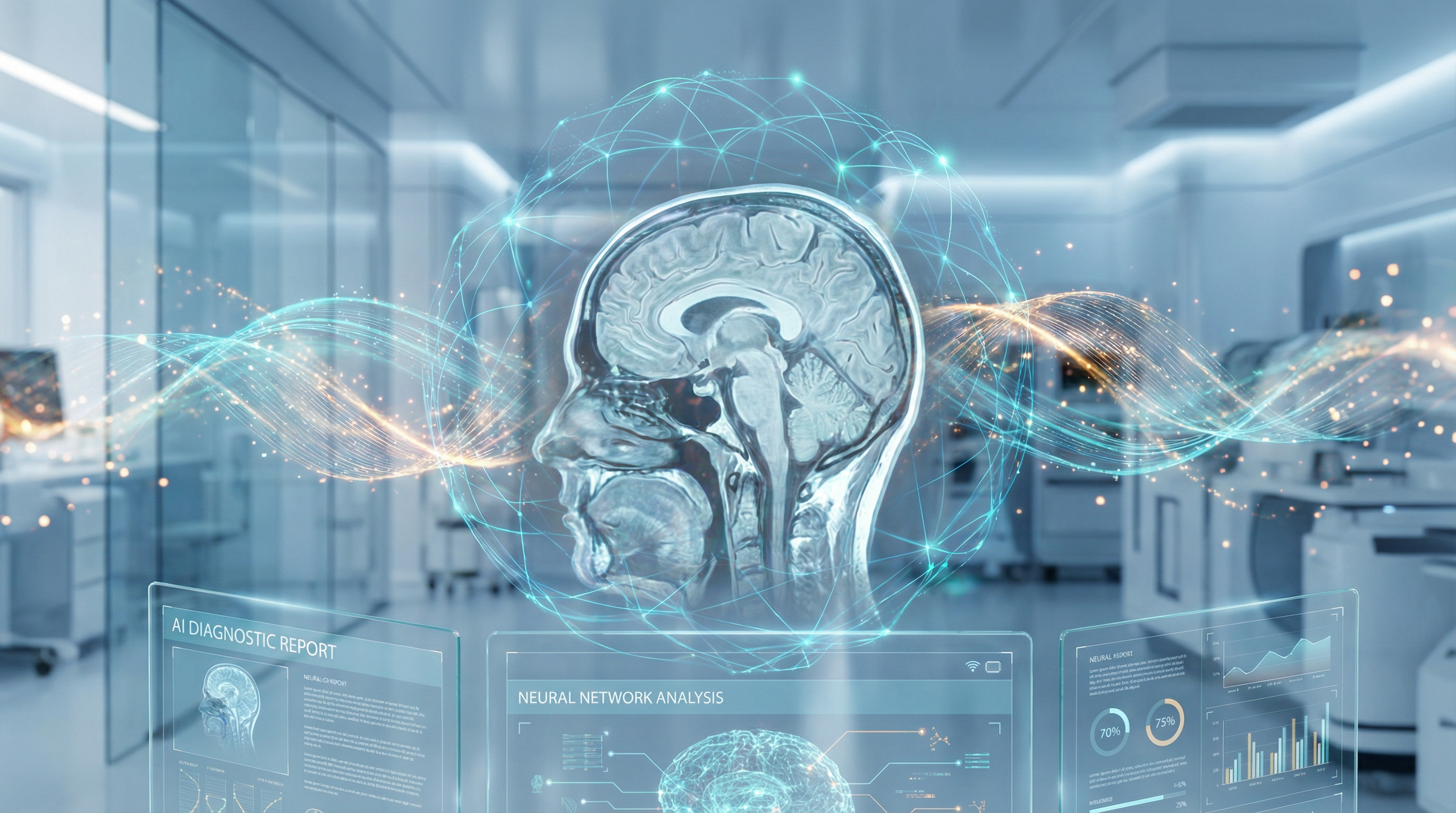
The Future of Diagnosis: How AI is Revolutionizing Brain Scans
In the fast-paced world of medical technology, a groundbreaking development from the University of Michigan is poised to reshape how doctors diagnose and treat neurological conditions. Researchers have unveiled an artificial intelligence (AI) system named "Prima" that can interpret complex brain MRI scans in a matter of seconds, a task that traditionally takes human radiologists hours or even days. This innovation not only promises to accelerate diagnosis but also to enhance its accuracy, heralding a new era of efficiency and precision in patient care.
A Glimpse into the Crisis: The Challenge of Medical Imaging
Magnetic Resonance Imaging (MRI) is a cornerstone of modern neurology, providing intricate images of the brain that are vital for diagnosing a wide array of conditions, from strokes and tumors to degenerative diseases. However, the demand for these scans has skyrocketed, far outpacing the availability of specialized neuroradiologists who can interpret them. This growing disparity has created a critical bottleneck in many healthcare systems, leading to diagnostic delays, increased workloads for physicians, and, in some cases, a greater potential for error. In rural or under-resourced areas, the problem is even more acute, with patients often waiting extended periods for their results. It is within this challenging landscape that the Prima AI system emerges as a beacon of hope.
Introducing Prima: The AI Co-Pilot for Radiologists
Prima is not just another AI tool; it is a sophisticated "vision language model" (VLM) capable of processing and understanding images, video, and text simultaneously. Described by its creators as a "ChatGPT for medical imaging," Prima was trained on an unprecedented scale of real-world data. The team at the University of Michigan utilized their entire digitized archive of brain MRIs, encompassing over 200,000 studies and 5.6 million imaging sequences. Crucially, this vast visual dataset was integrated with corresponding patient medical histories and the clinical notes explaining why each scan was ordered. This holistic approach allows Prima to function much like a human radiologist, considering the full clinical context to arrive at a comprehensive understanding of a patient's condition.
How Prima Achieves Unprecedented Accuracy
The power of Prima lies in its deep learning architecture and the richness of its training data. Unlike previous AI models that were often trained on smaller, curated datasets to perform narrow tasks—such as identifying a specific type of lesion—Prima was designed for breadth and depth. By learning from a massive and diverse set of real-world clinical cases, it has developed the ability to recognize over 50 different radiologic diagnoses with an astonishing accuracy rate of up to 97.5%. Furthermore, Prima can assess the urgency of a case. For life-threatening conditions like a brain hemorrhage or a major stroke, the system can instantly flag the scan and automatically alert the most appropriate subspecialist, be it a neurosurgeon or a stroke neurologist. This immediate feedback loop can dramatically shorten the time between diagnosis and treatment, a critical factor in improving patient outcomes for time-sensitive neurological emergencies.
Transforming Patient Care from the Inside Out
The clinical applications of Prima are vast and transformative. For patients, the most immediate benefit is the speed of diagnosis. The anxiety-filled wait for MRI results can be reduced from days to mere moments. This rapid turnaround allows for quicker initiation of treatment, which can be life-saving in many neurological emergencies. For physicians, Prima acts as a powerful "co-pilot," augmenting their expertise and streamlining their workflow. By handling the initial interpretation and flagging urgent cases, the AI frees up radiologists to focus on the most complex and nuanced interpretations, reducing burnout and improving the overall quality of care. Dr. Todd Hollon, the senior author of the study, emphasizes that the goal is not to replace physicians but to empower them. "Like the way AI tools can help draft an email or provide recommendations," he states, "Prima aims to be a co-pilot for interpreting medical imaging studies."
Bridging the Gap in Healthcare Access
Beyond the walls of major medical centers, Prima holds the potential to democratize access to high-quality diagnostic imaging. Rural and community hospitals often struggle with a shortage of on-site radiology specialists. Prima can act as a virtual consultant, providing immediate, expert-level analysis of brain scans regardless of the patient's location. This capability can level the playing field, ensuring that patients in underserved areas receive the same standard of diagnostic care as those in major urban centers. As Dr. Vikas Gulani, Chair of the Department of Radiology at U-M Health, notes, "innovative technologies are needed to improve access to radiology services." Prima represents a scalable and powerful solution to this long-standing challenge.
The Dawn of a New Era in Medical AI
While the initial results are incredibly promising, the journey for Prima is just beginning. The research team is already working on enhancing the system by integrating more detailed electronic medical record data to further refine its diagnostic accuracy. The underlying technology is also adaptable. The same principles that allow Prima to interpret brain MRIs could be applied to other forms of medical imaging, such as mammograms, chest X-rays, and ultrasounds, opening up a vast new frontier for AI in medicine. This breakthrough represents a paradigm shift from narrow AI tools to comprehensive, context-aware systems that can truly collaborate with medical professionals. The integration of large-scale health system data with sophisticated AI models is not just an incremental improvement; it is a transformative leap forward in the quest to provide better, faster, and more accessible healthcare for all.
Conclusion: A Smarter, Faster Future for Health
The development of the Prima AI system at the University of Michigan is more than just a technological achievement; it is a profound step towards a future where artificial intelligence and human expertise work in synergy to solve some of healthcare's most pressing challenges. By delivering rapid, accurate, and context-aware diagnoses, Prima has the potential to save lives, reduce the burden on healthcare professionals, and improve access to critical medical services. As this technology continues to evolve and expand, it will undoubtedly become an indispensable tool in the modern medical landscape, driving a new standard of care and offering a brighter, healthier future for patients around the world.